What does this page calculate?
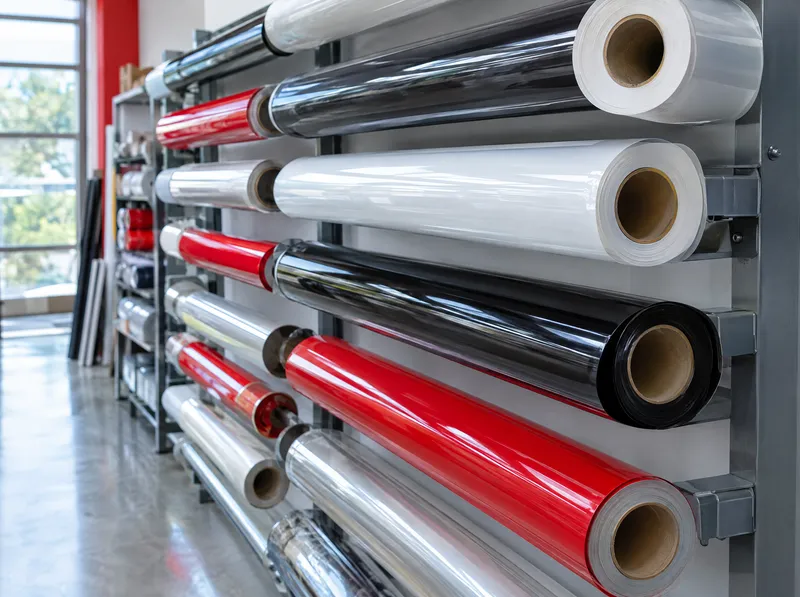
A half-used roll in the workshop raises the question “will this job fit?” before you start. The tool calculates how many metres are left, the share of a full roll, the remaining m² if you enter the roll width, and lower and upper bounds for measuring error. The page opens with the calibration method and a 50 m, 126 cm wide calendered vinyl roll: full diameter 145 mm, today 120 mm, core 83 mm.
Three methods
- Diameter: enter today’s outer diameter, the core’s outer diameter and the wrap thickness. Fastest, but the thickness is a preset.
- Calibration (recommended): enter the full roll length and outer diameter once; the tool finds the real wrap thickness. Remaining = full length × (D² − d²) ÷ (D_full² − d²).
- Weight: weigh the full roll, the empty core and today’s roll. Remaining = full length × (m − m_core) ÷ (m_full − m_core). The method least sensitive to measuring errors.
The real trap: thickness
Each wrap on the roll is not just film; film + adhesive + release liner are wound together. ORACAL 651 film is 70 µm, but with its 137 g/m² liner one wrap is about 0.22 mm. Calculating with film thickness alone overstates the remaining length about threefold. Calibration removes this guess.
Example: 50 m calendered vinyl
Full diameter 145 mm, core 83 mm, roll 50 m. The tool finds the wrap thickness π × (145² − 83²) ÷ (4 × 50,000) ≈ 0.222 mm. With today’s diameter of 120 mm the remaining length is 50 × (120² − 83²) ÷ (145² − 83²) ≈ 26.6 m, about 53% of a full roll. At 126 cm width that is about 33.5 m². A ±2 mm diameter error keeps the result between 24.9 and 28.3 m. At 95 mm about 7.6 m is left and the tool shows a reorder warning.
How to use the result
The formula assumes tight, even winding; loose or telescoped rolls hold a little less. Before a critical job, plan with the lower bound. If little is left, add the same product and roll width to the basket and request a quote; our branch will reply with price and stock. You can compare with the length of your print job from the print calculator.
Source: formula from a Signs101 forum table and the ring-area derivation; calibration and weight methods from FireSprint and Signs101 user methods; ORACAL 651 and Avery MPI 1105 thicknesses from manufacturer data sheets. Liner thickness was estimated from its weight; values are approximate.
Last updated: 20 October 2026 · Full tool page