How to Choose an LED Power Supply: Amps and Watts
Choosing an LED power supply (driver): total watts, the 80 percent load rule, 12 V indoor and outdoor ratings, IP67 and cable cross-section.
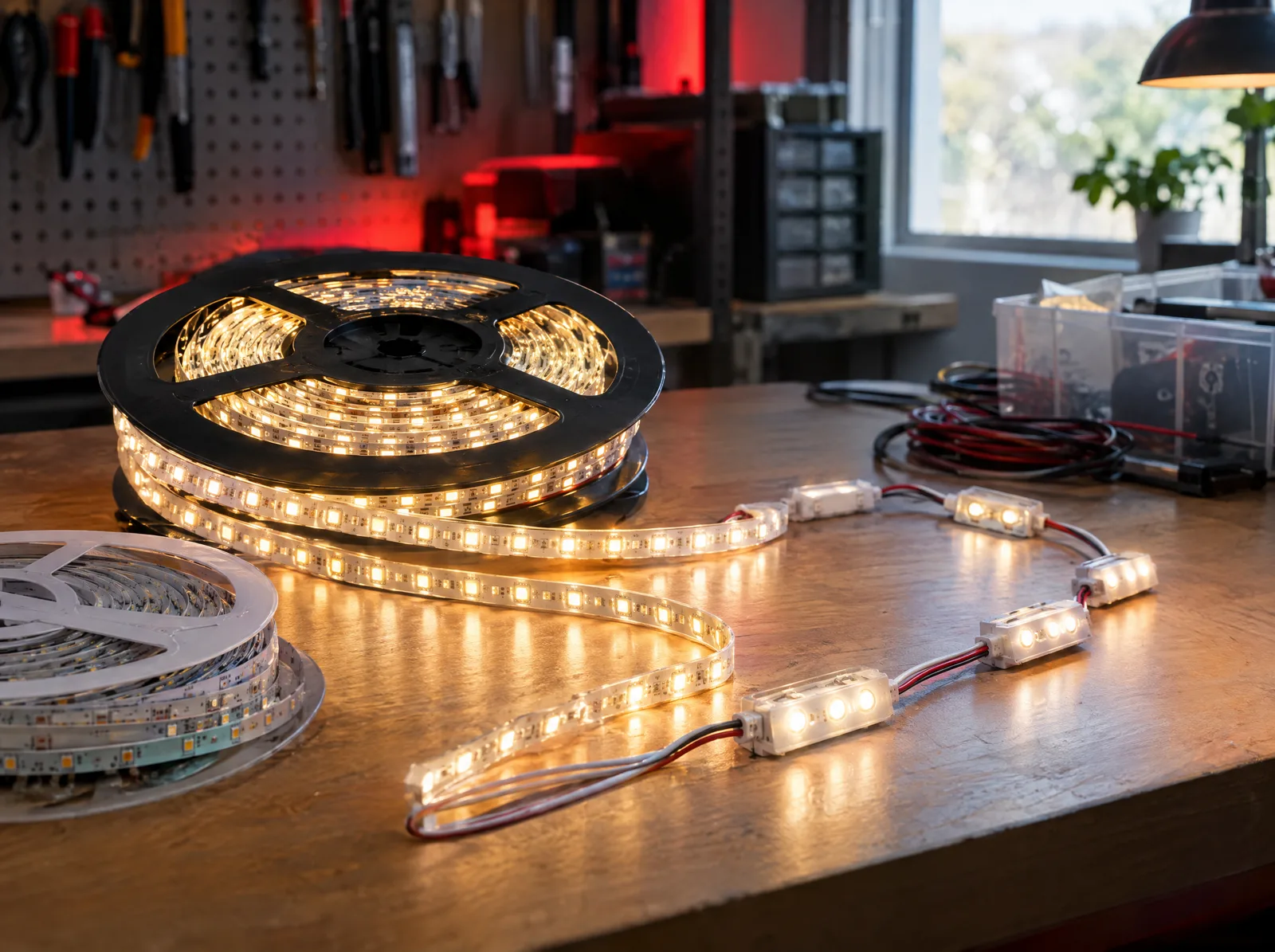
An LED power supply converts mains voltage to the low voltage LEDs use, most often 12 V. Choosing one takes three steps: find the total power, add a safety margin and match the environment.
1. Total power
Modules: watts per module × number of modules. Strips: watts per metre × length (the W/m value is on the label). Example: 80 modules of 1.5 W = 120 W.
2. The 80 percent rule
Do not run a power supply at full load. The load should be at most 80 percent of its rating:
Required power = total LED watts ÷ 0.8
For 120 W: 120 ÷ 0.8 = 150 W, so a 150 W (12.5 A) unit. Current is A = W ÷ V, so 150 ÷ 12 = 12.5 A.
3. Stocked 12 V ratings
| Indoor | Outdoor (examples) |
|---|---|
| 120 W / 10 A | 60 W / 5 A, 100 W / 8.5 A, 120 W / 10 A |
| 150 W / 12.5 A | 150 W / 12.5 A, 200 W / 16.5 A, 250 W / 20 A |
| 200 W / 16.5 A | 300 W / 25 A, 400 W / 33 A, 500 W / 41.6 A, 600 W / 50 A |
Outdoor units go up to 700 W (58.3 A) in the rainproof series, and a 24 V 300 W unit also exists. Match the voltage to your LEDs.
Outdoor use and IP67
Outdoors, use a rainproof power supply with a suitable IP rating such as IP67, and make connections watertight. Electrical work must be done by qualified people.
Several power supplies and cables
Connect LED groups in parallel to the supply. Never join the outputs of two power supplies; let each feed its own group. Respect the maximum module chain length. For cables, voltage drop ≈ 2 × length (m) × current (A) ÷ (56 × cross-section mm²) for copper. Example: 5 A, 3 m, 1.5 mm² gives about 0.36 V, roughly 3 percent of 12 V.
The LED calculator does this for you. Related products: indoor power supply, outdoor power supply, LED module, LED strip. Ready-made scenarios: LED strip power supply calculator, channel letter LED calculator.
FAQ
How many watts should the LED power supply be?
Divide total LED watts by 0.8 and pick the next rating up.
Why not use the full capacity?
Continuous full load heats the unit and shortens its life. The 20 percent margin covers heat and surges.
Can an indoor power supply be used outdoors?
No. Use a rainproof unit with a suitable IP rating.
This article contains general information; confirm dimensions and technical values before production.