What Is a COB LED Strip? Difference from SMD
A COB LED strip gives a continuous, dot-free line of light. Differences from SMD, W/m, cut points and power supply selection.
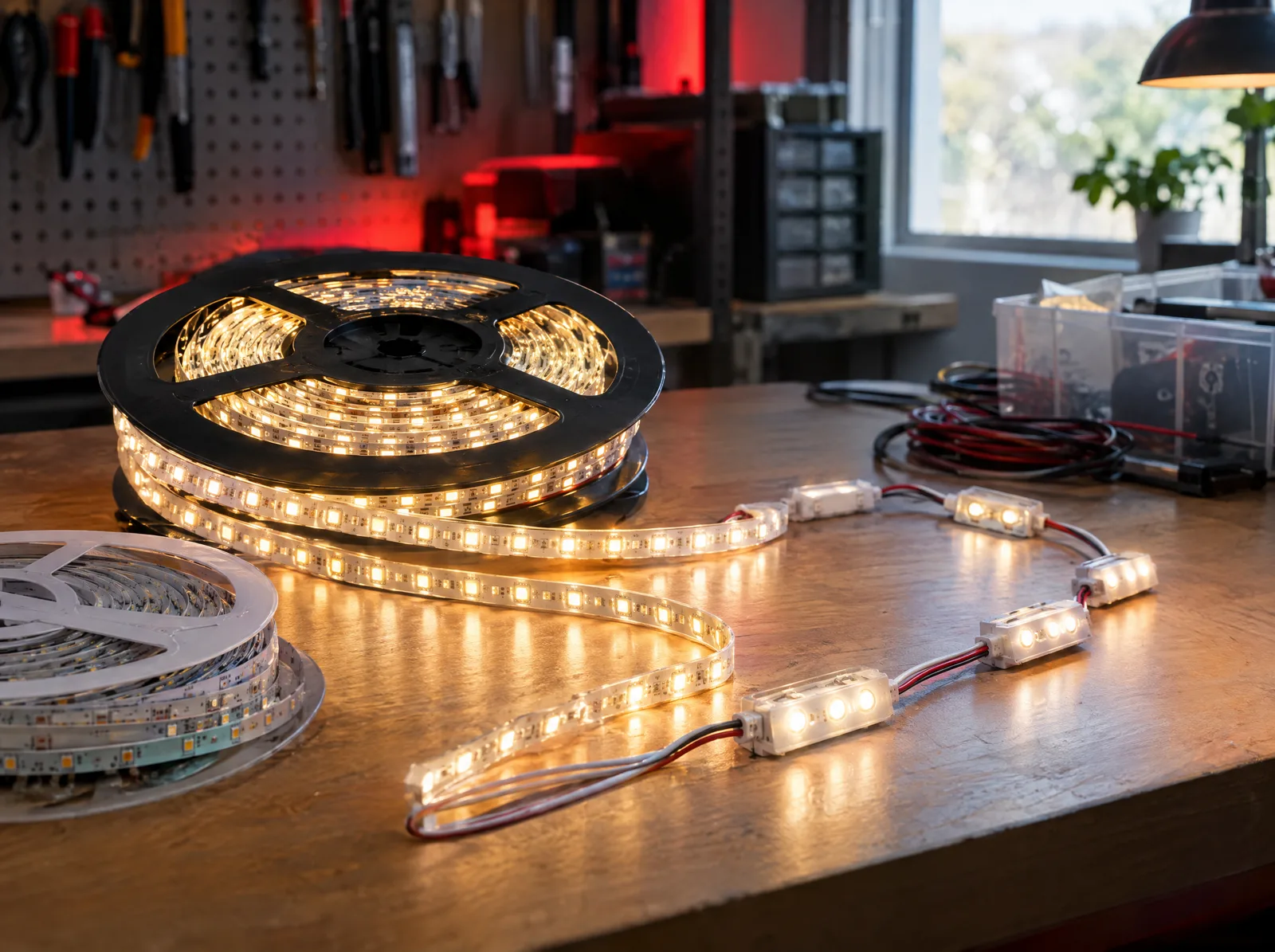
A COB LED strip has many bare LED chips mounted directly on the board and covered with a phosphor layer (“chip on board”). The result is a continuous line of light without visible dots.
| SMD strip | COB strip | |
|---|---|---|
| Look | Visible dots | Continuous |
| Close mounting | Needs diffuser or profile | Even without a profile |
| Colours | White tones, RGB | Mostly single white tones |
| Cost | Usually lower | Usually higher |
Sources: Simple Lighting, Govee.
Use and products
COB suits shop windows, shelves, thin channel letters and profile lighting. Our COB LED strip is a 2835 COB type with IP65 and IP67 options. A COB module (daylight, 190 lumen) is also stocked.
W/m and cutting
W/m is printed on the label; do not guess. Strips can only be cut at the marked cut points, spaced a few centimetres apart depending on the product.
Power supply
Total watts = W/m × metres. Required supply = total watts ÷ 0.8. Example (assumed value): 10 W/m × 6 m = 60 W; 60 ÷ 0.8 = 75 W, so a 100 W (8.5 A) 12 V supply. Feed long runs from both ends to avoid voltage drop. See the LED calculator and the product COB LED strip. Ready-made scenario: LED strip power supply calculator.
FAQ
What is the difference between COB and SMD?
COB chips are densely packed and look dot-free; SMD chips are separate and visible. COB usually costs more.
Can a COB strip be cut?
Yes, only at the marked cut points.
Is there an RGB COB strip?
Most COB strips are single-colour white tones; RGB is more common in SMD.
This article contains general information; confirm dimensions and technical values before production.